Automated fitting or creation of custom S-vine distribution models
Usage
svine(
  data,
  p,
  var_types,
  margin_families = univariateML::univariateML_models,
  selcrit = "aic",
  ...
)
Arguments
- data
a matrix or data.frame of data.
- p
the Markov order.
- var_types
variable types; a character vector with one entry per variable:
"c"for continuous,"d"for discrete. Defaults to all-continuous when missing.- margin_families
either a character vector of univariateML::univariateML_models to select from for every margin, or a list with one entry for every variable. For a discrete variable, the corresponding entry must contain only suitable discrete families. Use
"empirical"for empirical CDFs.- selcrit
criterion for family selection, either
"loglik","aic","bic","mbicv".- ...
arguments passed to
svinecop().
Value
Returns the fitted model as an object with classes
svine and svine_dist. A list with entries
$margins: list of marginal models from univariateML::univariateML_models,$copula: an object ofsvinecop_dist.
References
Nagler, T., Krüger, D., and Min, A. (2022). Stationary vine copula models for multivariate time series. Journal of Econometrics, 227(2), 305–324. doi:10.1016/j.jeconom.2021.11.015 .
Examples
# load data set
data(returns)
# fit parametric S-vine model with Markov order 1
fit <- svine(returns[1:100, 1:3], p = 1, family_set = "parametric")
#> Loading required namespace: intervals
fit
#> 3-dimensional S-vine distribution model of order p = 1 ('svine_dist')
summary(fit)
#> $margins
#> # A data.frame: 3 x 5
#> margin name model parameters loglik
#> 1 Allianz Logistic 0.0015, 0.0073 292
#> 2 AXA Logistic 0.0029, 0.0084 277
#> 3 Generali Logistic 0.00088, 0.00770 286
#>
#> $copula
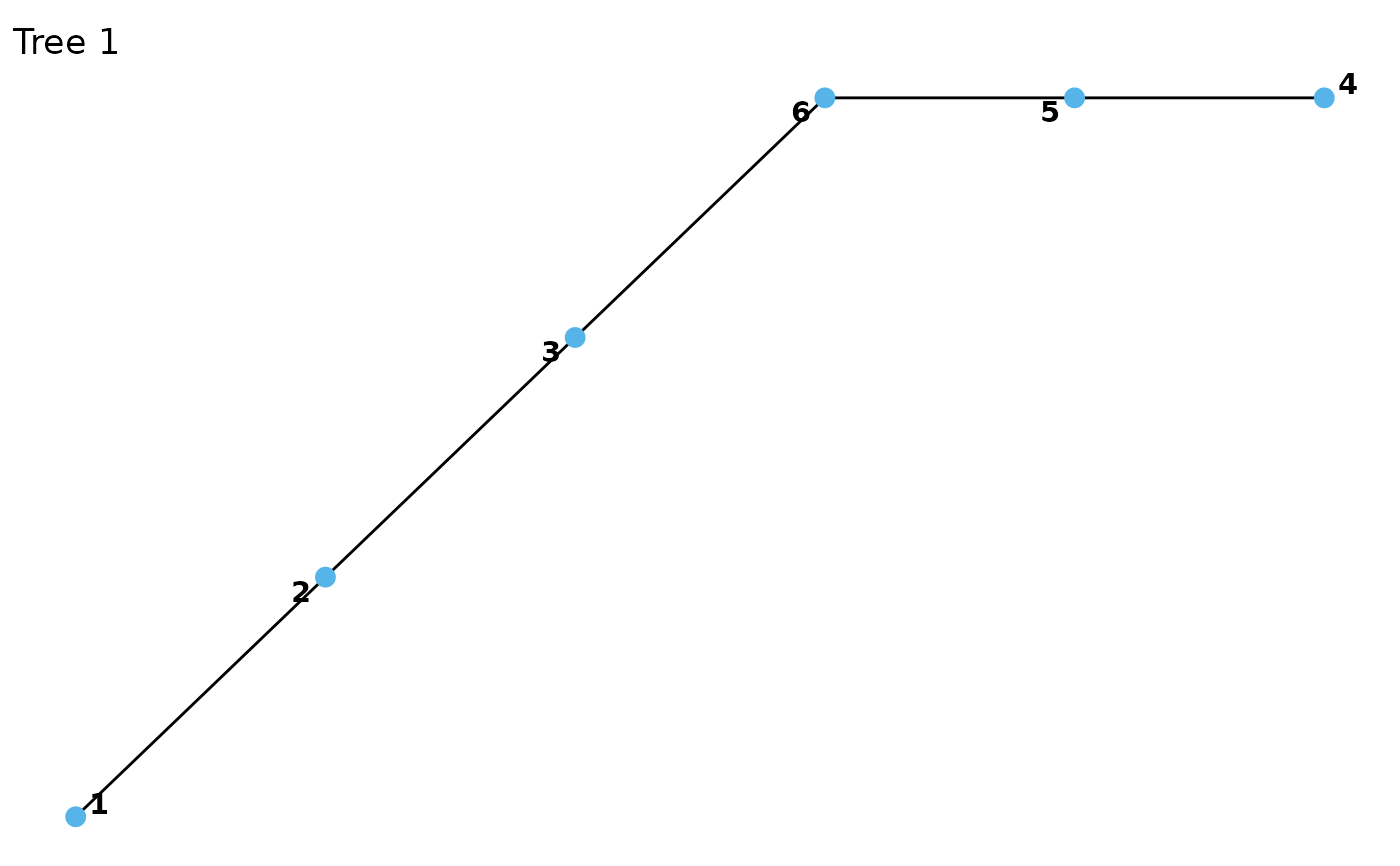
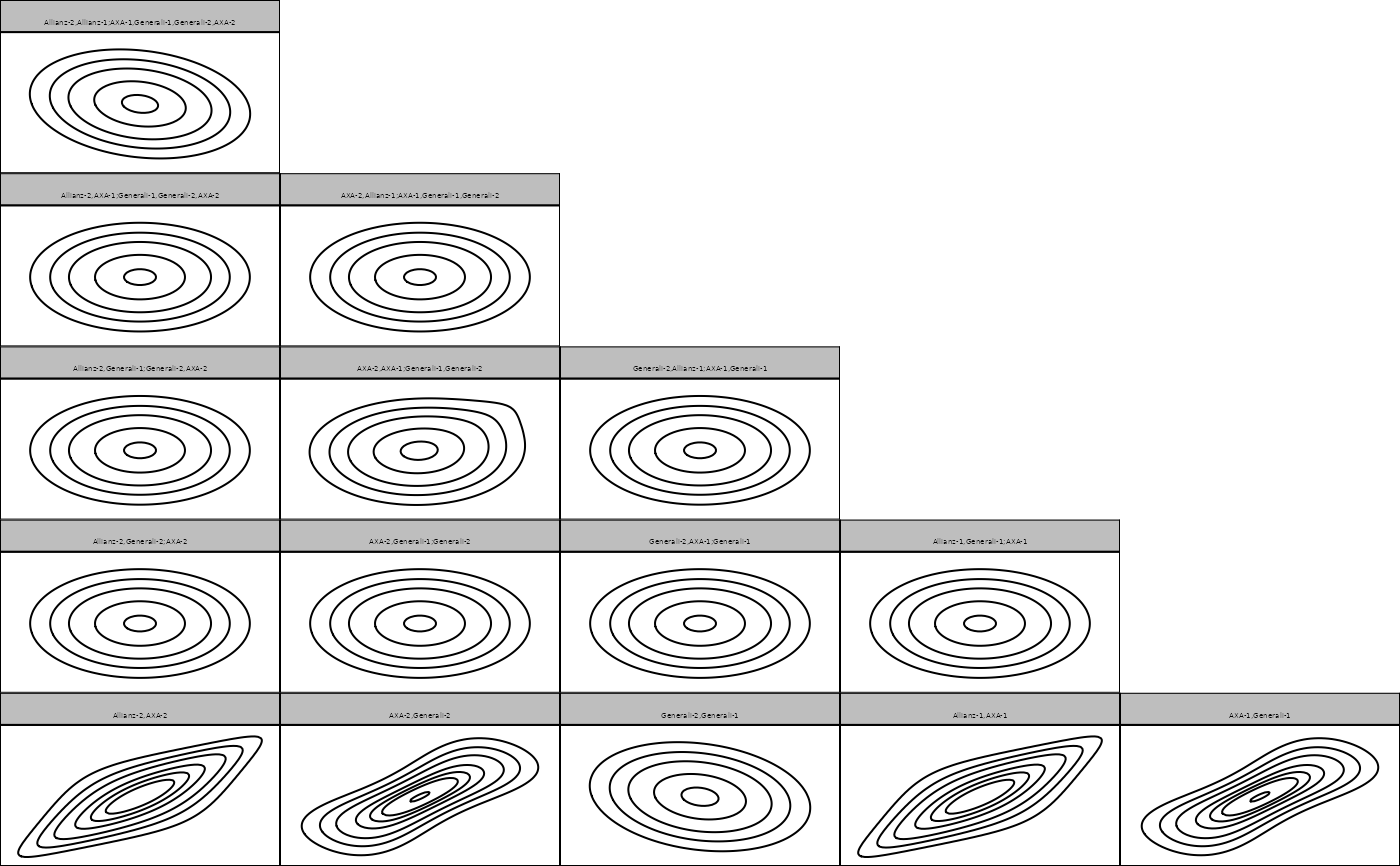
#> # A data.frame: 12 x 10
#> tree edge conditioned conditioning var_types family rotation parameters df
#> 1 1 6, 3 c,c gaussian 0 -0.2 1
#> 1 2 1, 2 c,c t 0 0.72, 3.66 2
#> 1 3 2, 3 c,c frank 0 7.4 1
#> 2 1 5, 3 6 c,c indep 0 0
#> 2 2 6, 2 3 c,c indep 0 0
#> 2 3 1, 3 2 c,c indep 0 0
#> 3 1 4, 3 6, 5 c,c indep 0 0
#> 3 2 5, 2 3, 6 c,c joe 0 1.1 1
#> 3 3 6, 1 2, 3 c,c indep 0 0
#> 4 1 4, 2 3, 6, 5 c,c indep 0 0
#> tau
#> -0.128
#> 0.516
#> 0.580
#> 0.000
#> 0.000
#> 0.000
#> 0.000
#> 0.055
#> 0.000
#> 0.000
#> # ... with 2 more rows
#>
plot(fit$copula)
 contour(fit$copula)
 logLik(fit)
#> [1] 942.4027
#> attr(,"df")
#> [1] 12
#> attr(,"nobs")
#> [1] 100
pairs(svine_sim(500, rep = 1, fit))
logLik(fit)
#> [1] 942.4027
#> attr(,"df")
#> [1] 12
#> attr(,"nobs")
#> [1] 100
pairs(svine_sim(500, rep = 1, fit))